
No products added!
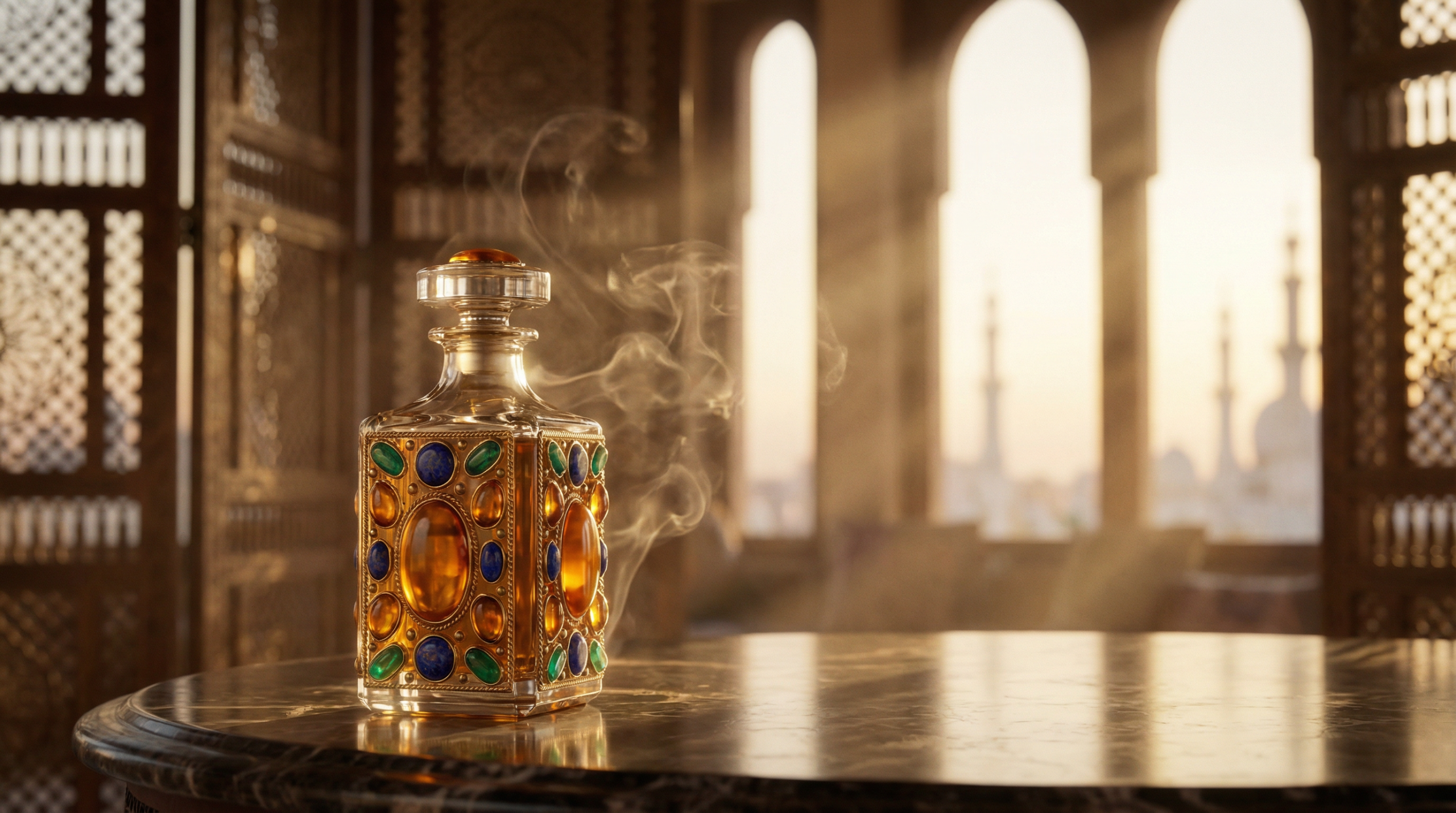

If you’ve ever wondered why your carefully chosen luxury fragrance seems to disappear within hours of stepping into Dubai’s scorching sun, you’re not alone. The UAE’s unique climate presents distinct challenges for perfume longevity that women across the GCC region face daily. Understanding the science behind this phenomenon—and the culturally rooted solutions available—can transform your relationship with fragrance.
The Science of Scent: Why Heat Accelerates Evaporation
The desert climate fundamentally alters how perfumes perform on your skin. When temperatures soar above 40°C during summer months, the volatile aromatic compounds in fragrances evaporate at an accelerated rate. This process, known as volatilization, intensifies dramatically with every degree increase.
Your skin temperature also rises in response to ambient heat, creating a warmer surface that speeds up evaporation even further. The molecular structure of fragrance compounds begins breaking down faster, particularly those delicate top notes crafted from citrus, florals, and light aldehydes. What might last six hours in a temperate climate can fade within two hours in the UAE’s intense heat.
Additionally, the alcohol base in most Western perfumes—typically ethanol at 70-90% concentration—evaporates rapidly when exposed to high temperatures. This carrier substance vanishes quickly, taking precious scent molecules with it before they have time to fully develop on your skin.
Beyond the Obvious: Unpacking the UAE’s Unique Climate Impact on Fragrance
The challenge isn’t heat alone. The UAE’s climate combines multiple factors that create a perfect storm for fragrance fade. Indoor-outdoor temperature differentials of 20°C or more cause rapid expansion and contraction of scent molecules, disrupting their intended release pattern.
Humidity levels, while variable, interact with perfume chemistry in unexpected ways. During humid months, moisture can actually interfere with how fragrance bonds to your skin’s natural oils. The constant transition between air-conditioned interiors and outdoor heat also causes synthetic molecules to behave erratically, often resulting in distorted scent profiles.
Direct sunlight presents another dimension to consider. UV radiation doesn’t just accelerate evaporation—it can chemically alter certain fragrance components, particularly synthetic musks and some floral absolutes, changing the scent itself rather than merely shortening its wear time.
Ancient Wisdom Meets Modern Luxury: The Art of Layering and Application for Longevity
Traditional Arabian perfumery offers time-tested solutions that predate modern chemistry. The practice of applying fragrance to pulse points takes on new meaning in extreme heat. Rather than the typical wrists and neck, consider cooler areas like behind the knees, inner elbows, or even hair ends, where evaporation occurs more slowly.
Layering remains one of the most effective techniques for fragrance longevity. Begin with an unscented moisturizer or a matching scented oil to create a base layer. This hydrated foundation helps anchor volatile compounds, extending their presence on your skin. The technique mirrors the traditional Arabian practice of building scent in stages rather than relying on a single application.
Application to clothing and hair scarves offers culturally appropriate alternatives that bypass skin temperature entirely. Natural fabrics like silk, cotton, and wool absorb and release fragrance gradually, creating a personal scent cloud that lasts significantly longer than skin application alone.
The Enduring Power of Oud & Attars: Culturally Rooted Solutions for Lasting Fragrance
Oud and traditional attars have endured in the Gulf region precisely because they’re formulated for this climate. These oil-based concentrates contain minimal alcohol, eliminating the rapid evaporation problem that plagues alcohol-based fragrances. The resinous, woody nature of oud itself comprises heavier base note molecules that resist heat-driven volatilization.
Attars—steam-distilled natural essences suspended in sandalwood oil—offer exceptional longevity because their carrier oil evaporates far more slowly than alcohol. A single drop can last twelve hours or more, even in intense heat. The concentrated nature of these traditional perfumes means they’re designed to be applied sparingly, making them economically sensible despite their premium pricing.
The cultural wisdom embedded in these fragrances reflects centuries of adaptation to desert climates. Women in the region have long understood that heavier, oil-based scents with substantial base notes simply perform better when temperatures climb.
The Future of Scent: How Gemstone Infusions and Natural Essences Offer a 2026 Fix
The luxury perfume landscape in 2026 has evolved to address climate-specific challenges through innovative formulations. Gemstone-infused perfumes represent a fascinating intersection of traditional energy practices and modern perfumery, with proponents suggesting that crystal essences help stabilize volatile compounds.
These formulations often incorporate crushed gemstone particles or crystal-charged essences that theoretically create a more cohesive molecular structure, slowing evaporation rates. While scientific validation remains ongoing, anecdotal evidence from users in hot climates suggests improved longevity compared to conventional formulations.
Natural essence concentrations have also increased significantly in luxury perfumes designed for Middle Eastern markets. Higher percentages of absolutes, concretes, and CO2 extracts—which contain less volatile components than steam-distilled oils—create fragrances with inherently better staying power in heat.
Beyond the Bottle: Holistic Approaches to Fragrance Preservation in High Heat
Proper storage becomes non-negotiable in the UAE climate. Keep perfume bottles away from direct sunlight and store them in cool, dark spaces—ideally between 15-20°C. Bathroom storage, despite its convenience, exposes fragrances to humidity and temperature fluctuations that degrade them rapidly.
Consider decanting small amounts into travel atomizers, keeping the main bottle sealed and cool. This minimizes air exposure for your primary supply while ensuring you have fragrance accessible for daily use. Glass atomizers preserve scent integrity better than plastic alternatives.
Timing your application matters significantly. Applying perfume immediately after showering, while skin remains slightly damp, helps lock in scent. The moisture acts as a temporary barrier, slowing initial evaporation and allowing middle notes more time to develop before the heat takes effect.