
No products added!

Unveiling the 30-50-20 Rule: A Foundation in Fragrance Architecture
At the heart of every memorable fragrance lies a carefully orchestrated balance—and in 2025, understanding this balance has become essential for anyone who appreciates the art of perfumery. The 30-50-20 rule represents the traditional proportions of perfume composition: 30% top notes, 50% heart notes, and 20% base notes.
Top notes create the first impression, typically lasting 15 to 30 minutes. These are the bright, volatile scents—citrus, herbs, light florals—that greet your senses immediately upon application. The heart notes, comprising half the composition, emerge as the top notes fade and form the perfume’s true character. These middle accords, often floral, spicy, or fruity, can last several hours.
The base notes anchor the entire composition with depth and longevity. Rich, heavy molecules like amber, musk, woods, and resins form this foundational 20%, persisting on skin for hours or even days. This mathematical precision ensures a fragrance unfolds beautifully over time rather than overwhelming or disappearing too quickly.
The Soul of Arabic Perfumery: Adapting the Rule with Oud and Traditional Elements
Traditional Arabic perfumery takes the 30-50-20 framework and transforms it into something distinctly Middle Eastern. The most significant departure lies in the base notes—rather than the standard 20%, Arabic compositions often dedicate 30-40% to the foundation, creating the legendary longevity these fragrances are known for.
Oud, the prized resinous wood, exemplifies this philosophy. As a base note with extraordinary staying power, oud can dominate a blend in ways Western perfumery might consider unbalanced. Yet this “unbalance” creates the intense, long-lasting sillage that GCC markets cherish.
Regional preferences also influence the heart notes. While Western perfumery might favor delicate florals, Arabic blends often incorporate robust spices—saffron, cardamom, cinnamon—that can withstand the weight of heavier base notes. Rose, particularly taif rose, appears frequently but in richer, more concentrated forms.
The top notes in Arabic perfumery serve as brief, sparkling introductions before quickly yielding to the composition’s true soul. Bergamot, orange blossom, and jasmine might appear, but they’re supporting players in a drama where the base notes command center stage.
Beyond Scent: Infusing Luxury with Gemstone Energies and Chakra Alignment
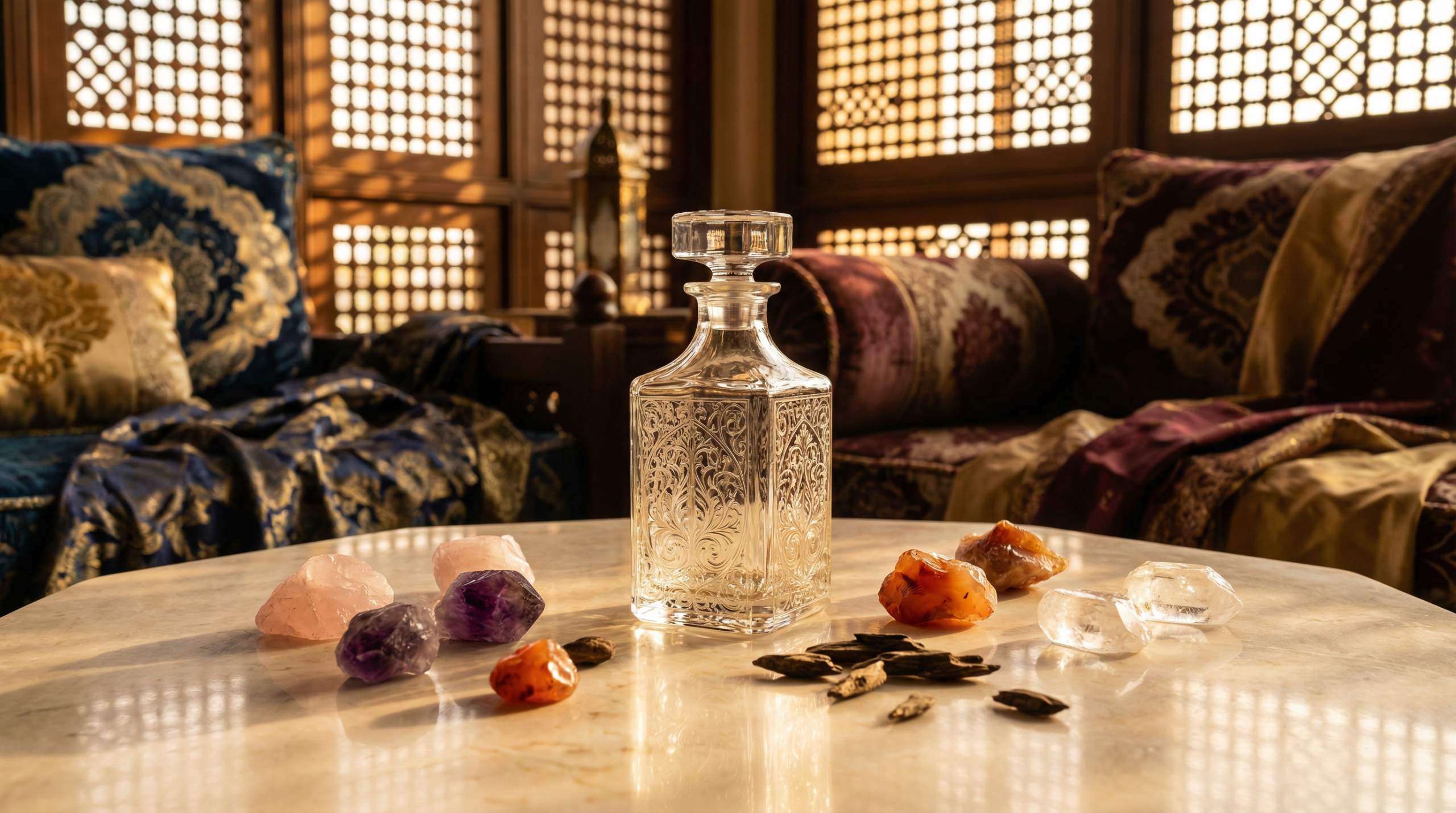
The evolution of luxury perfumery in 2025 has embraced an ancient practice: gemstone infusion. This sophisticated technique involves placing precious stones in essential oils or finished fragrances, allowing their energetic properties to subtly influence the blend’s character.
Rose quartz, associated with the heart chakra, pairs naturally with rose absolutes and soft florals in the heart notes. Practitioners believe this combination enhances qualities of self-love and compassion. Amethyst, linked to clarity and spiritual awareness, often accompanies frankincense and sandalwood in contemplative base note blends.
Carnelian complements warm, spicy heart notes like cinnamon and ginger, thought to boost confidence and vitality. Clear quartz, considered an amplifier, can be used across all note categories to intensify a fragrance’s overall energy and presence.
This practice honors the Islamic tradition of appreciating natural materials and their inherent properties. The gemstone infusion process requires patience—stones typically remain immersed for lunar cycles, creating fragrances that transcend mere scent to become holistic experiences.
Crafting Your Signature: Practical Application and Future Blending Trends for 2025
Understanding the 30-50-20 rule empowers you to create personalized fragrance wardrobes through layering—a cherished tradition in Gulf culture. Start with a heavier, oud-based composition as your foundation, then layer lighter attars or oils to customize the top and heart notes.
For daytime wear in the region’s climate, consider maintaining traditional ratios but selecting lighter materials within each category. A 30% top of bergamot and neroli, 50% heart of jasmine and light spices, and 20% base of white musk creates elegance without overwhelming in heat.
Evening and special occasions call for the bolder Arabic interpretation. A 20% top of saffron and citrus, 40% heart of rose and amber, and 40% base of oud and sandalwood delivers the dramatic presence appropriate for celebrations.
Looking forward in 2025, sustainable sourcing has become paramount. Cultivated oud and ethical harvesting practices ensure these traditions continue without environmental compromise. Bio-engineered molecules that replicate rare ingredients allow perfumers to maintain quality while preserving precious resources.
The Enduring Legacy: Why Arabic Blending Continues to Captivate
The 30-50-20 rule, reimagined through the lens of Arabic perfumery, represents more than mathematical proportions—it embodies a cultural philosophy where fragrance serves as personal expression, spiritual practice, and artistic legacy.
The integration of gemstone energies adds another dimension, transforming perfume from cosmetic luxury to holistic experience. This approach resonates deeply in markets where wellness, spirituality, and beauty intersect naturally.
As you develop your understanding of fragrance composition, remember that rules provide foundation, not limitation. The beauty of perfumery lies in how cultural traditions adapt universal principles to create something entirely unique. Whether you prefer balanced Western compositions or the bold depth of Arabic blends, this knowledge helps you appreciate the artistry in every bottle and make choices that truly reflect your personal aesthetic and values.